Certified records
A public leaderboard of retro scores that nobody can fake - and that anyone can verify, without trusting us. Here is everything that happens, from the game played to the proof on Bitcoin.
See the live leaderboard → Verify it yourself →
The chain of trust, at a glance
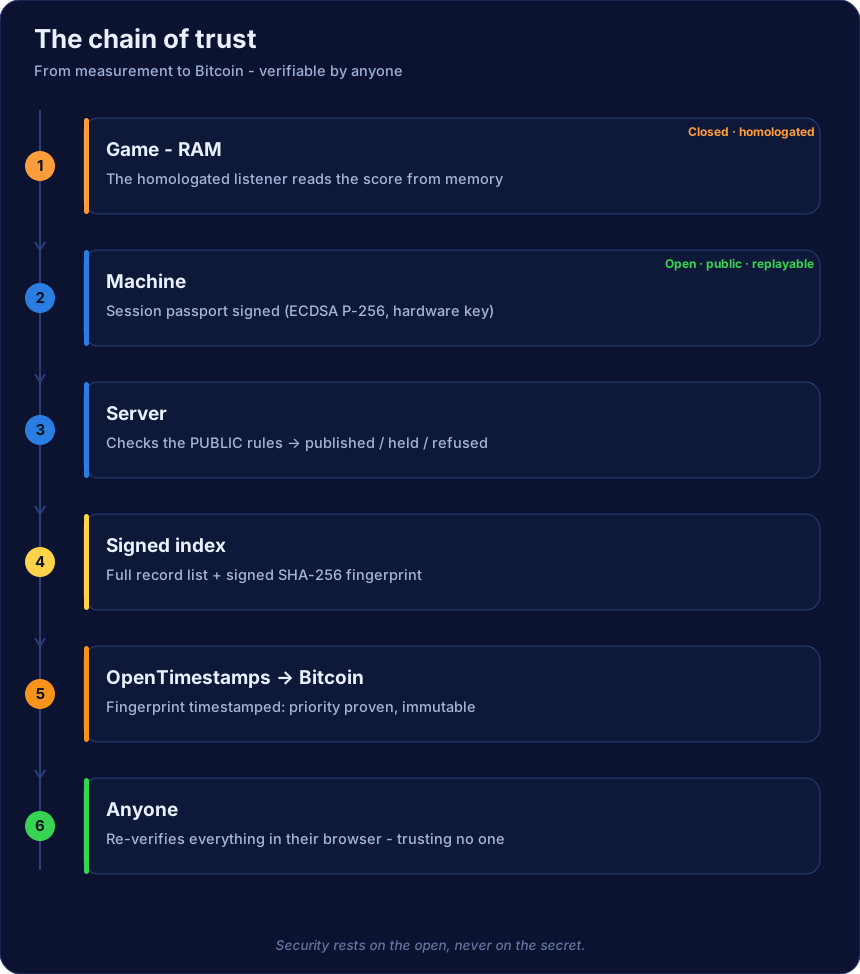
Every step is either public and replayable, or homologated and signed. Security never rests on a secret (Kerckhoffs' principle) - only on the open.
1 · Measured, not declared
The score is not sent by the game. A homologated component (the listener) reads the value straight from the emulator's memory, at the source, with timestamped checkpoints. No "declared" score ever enters the system.
2 · Signed on the machine
The cabinet assembles a session passport (score, core/dump/listener fingerprints, checkpoints, ticket) and signs it with a non-exportable hardware key (ECDSA P-256). One byte changed afterwards = invalid signature.
3 · Verified server-side
The server does not replay the game: it applies public rules (the open-source CoreVerifier) - expected fingerprints, trajectory monotonicity, game end, valid ticket - then returns a verdict: published, flagged (a macro replayed identically: the score stays with the player, never ranked nor sealed) or refused (software cheats, impossible inputs, non-compliant artifacts). An interrupted run keeps its score. No human referee.
4 · Published in a signed index
Published scores form a signed index: the full list + a SHA-256 fingerprint signed by the issuer. This index rebuilds the leaderboard - and makes a database loss inconsequential (it is rebuildable and mirrorable).
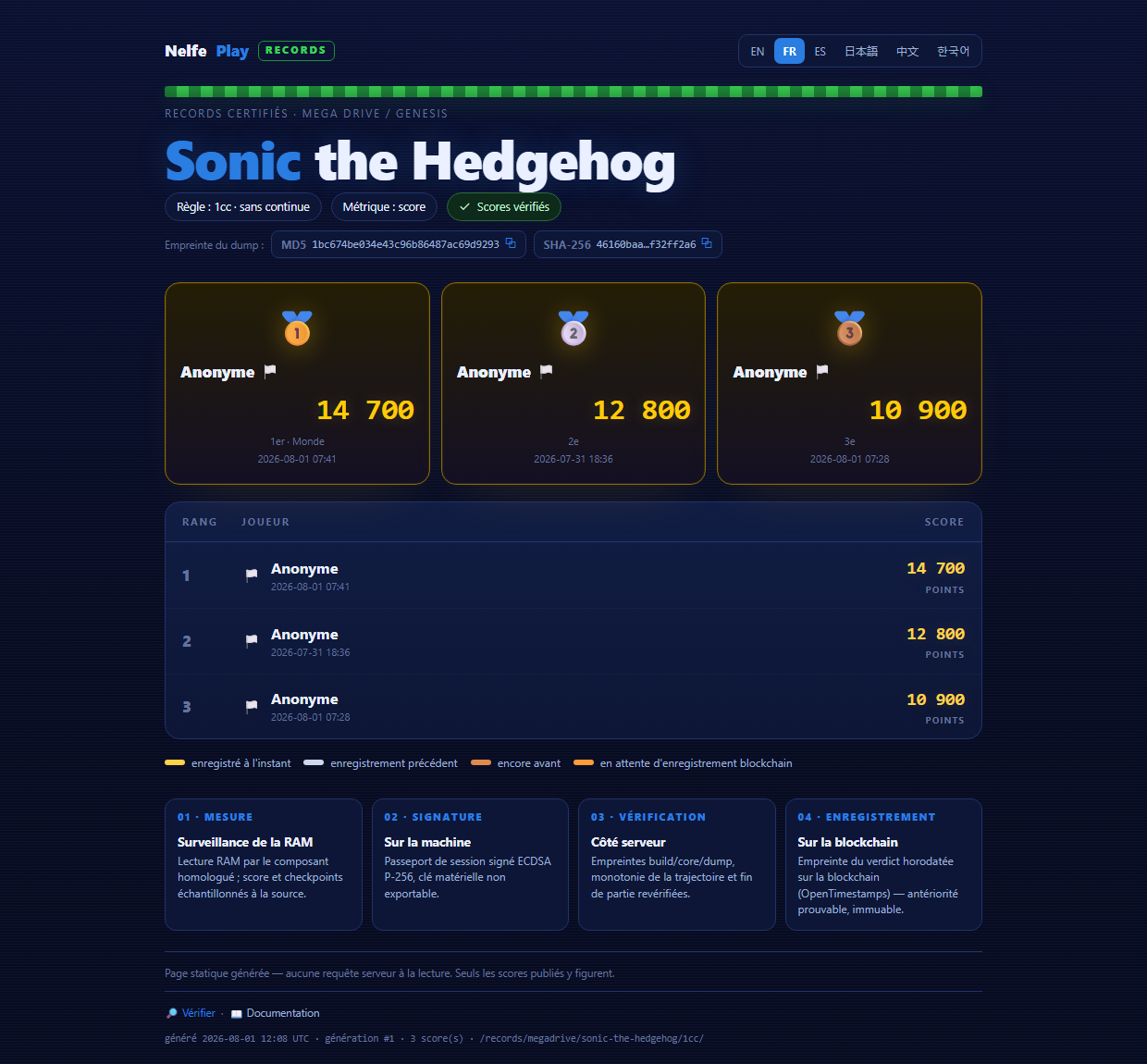
5 · Sealed on Bitcoin
The index fingerprint is timestamped on Bitcoin via OpenTimestamps. Once
confirmed, it proves the records existed before a given block - immutable
priority. A freshly sealed score shows in gold; the .ots proof is downloadable and
verifiable with the standard OpenTimestamps client.
6 · The record certificate
Each score has an immutable, shareable page: score, dump fingerprints (MD5 + SHA-256), signature ✓, and the Bitcoin seal (block). No rank on it - the rank lives on the leaderboard.
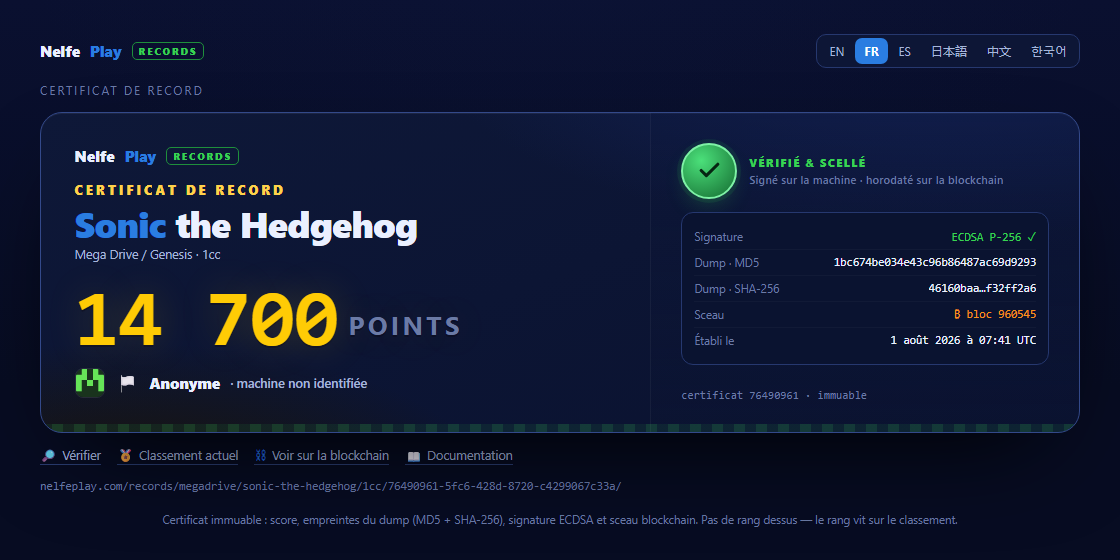
7 · Verifiable without trusting us
The public verifier recomputes the fingerprint, verifies the signature (Web Crypto) and reads the seal state - in your browser. It takes nothing at face value. You can even host it yourself.
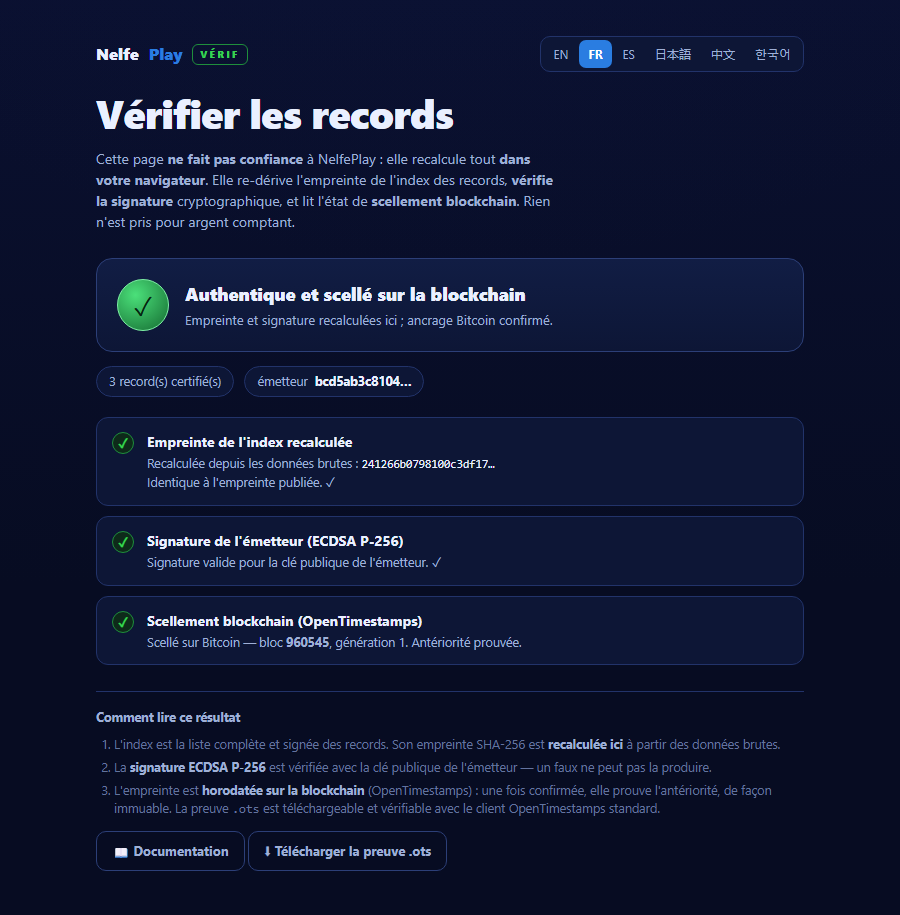
Verify now → Host the verifier →
The honest limit
The open protocol does not mathematically prove the closed listener read the right address. It proves the homologated build was present, bound to the right process, unmodified, and that the public rules were applied. Trust in the measurement comes from a listener that is homologated, signed, versioned, audited - see Transparency and Homologation.